
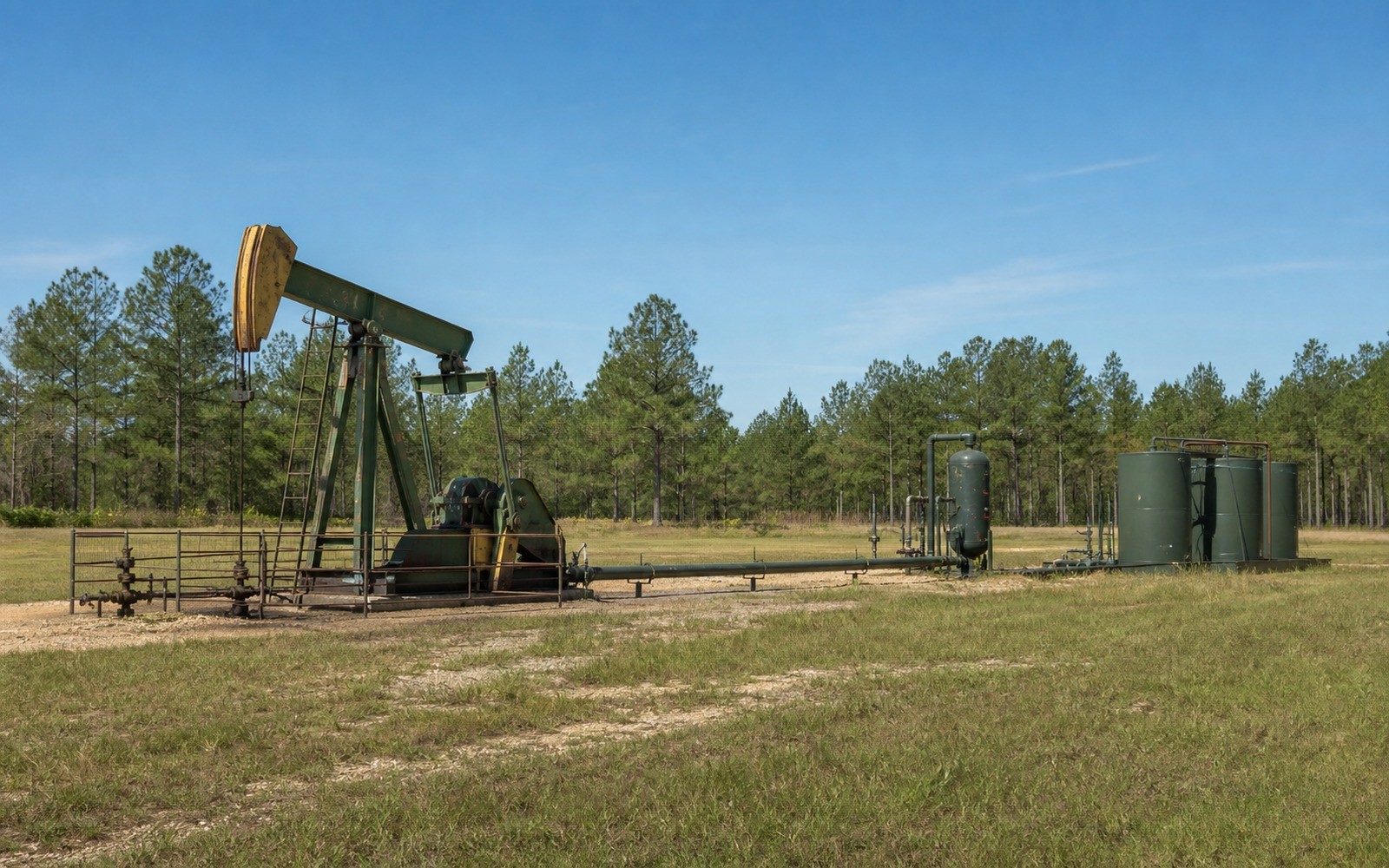
Black Warrior Basin Mineral Rights
Coalbed methane doesn't behave like shale gas or conventional gas, and an Alabama coal-seam royalty check reflects that from the day the well starts producing.
The Black Warrior Basin in west-central Alabama, running through Tuscaloosa, Fayette, Walker, and the surrounding counties, was one of the country's original coalbed methane plays going back to the 1980s. It's a different kind of gas production than most owners are used to hearing about — the gas is held in coal seams by water pressure rather than trapped in a conventional reservoir or fracked out of shale, and it has to be dewatered before the gas will flow in any real volume.
If you hold a mineral or royalty interest in Black Warrior coalbed methane, you're most likely behind a well drilled decades ago that's long since worked through its dewatering ramp-up and settled into a mature, low-volume production pattern that can hold steady for a long time.
The dewatering curve, explained plainly
A coalbed methane well doesn't produce much gas at all in its first months — sometimes the first year or more — because the coal seam has to be pumped down to reduce the water pressure holding the gas in place before methane desorbs and starts flowing. Owners new to CBM sometimes see a small or nonexistent check early on and assume the well failed. It didn't; it's doing exactly what a coal-seam well does, and gas production typically climbs as dewatering progresses before leveling into a mature rate.
Because almost all Black Warrior wells are decades past that ramp-up stage now, the interests we see today are typically on a long, established plateau or gradual decline rather than in the uncertain early dewatering phase. That maturity is actually an asset for valuation purposes — the well has already shown what it does.
Water handling and what it costs you
Water disposal is a real, ongoing cost on coalbed methane wells, since produced water has to be pumped, handled, and disposed of for the life of the well, well beyond startup. That cost typically shows up as a deduction on your royalty statement, and it's worth confirming your lease's post-production cost language actually allows the specific water-handling charges being deducted, since older Alabama CBM leases vary in how explicitly they address this.
Compression costs are also common, since coal-seam gas often comes out at low pressure and needs to be compressed to reach a sales line. Between water handling and compression, Black Warrior statements can show a meaningfully larger deduction relative to gross revenue than a conventional gas well of the same volume — that's normal for this kind of production, not a sign of an error, but it's still worth confirming the specific line items against your lease.
Ownership in Alabama coal country
A lot of Black Warrior mineral ownership traces back to coal-era land splits — surface and mineral rights that were separated generations ago when coal mining, not gas, was the dominant industry in this part of Alabama. That history means some owners hold gas rights separately from coal rights, and it's not unusual for us to talk to an owner who wasn't fully aware their family's mineral estate even included coalbed methane rights until a royalty check started showing up.
We also see fractional interests split among heirs who've never been to west Alabama, holding a small piece of a well that's been paying quietly for twenty or thirty years. Consolidating that into a lump sum is often more appealing than continuing to track a small quarterly check tied to land the family hasn't visited in decades.
How we approach a Black Warrior offer
Given how mature this basin is, we lean almost entirely on your actual production history rather than any speculative growth case — there's very little new Black Warrior CBM drilling to factor in. We'll look at your last several years of statements, confirm the well's current status with the state, and price the remaining reserves against current gas pricing and the well's demonstrated decline rate.
If you hold interests across multiple older Black Warrior wells, we can evaluate the whole package together, which is often simpler than tracking several small checks from different operators or different eras of drilling.
Owner questions
Questions a Royalty Owner Should Ask
Each answer ties the deposited amount back to the title, lease, unit, well, price, and adjustment records that produced it.
Why didn't your Black Warrior coalbed methane well pay much in its first year?
Coal-seam gas has to be dewatered before it flows in volume, so early checks on a new CBM well are typically small or minimal while the water pressure comes down. Production usually builds over that ramp-up period before leveling off.
Why are water handling costs deducted from your royalty?
Produced water is a continuous cost on coalbed methane wells and is commonly deducted as a post-production cost under most Alabama CBM leases. It's worth confirming the specific charges match what your lease allows.
Is Black Warrior coalbed methane still being developed?
Very little new CBM drilling happens in the basin today. Most producing wells are decades old and mature, so an existing interest is valued on established production history rather than future drilling potential.
Is a small inherited Black Warrior interest worth evaluating?
It can be. Even a small fractional interest in a long-producing coalbed methane well has value once we see the production and payment history, and it's common for heirs several generations removed from the original owner to still hold a sellable interest.
Related royalty reviews
Trace the next line behind the check
Each of these reviews turns on the same statement detail: the owner decimal, the wells behind it, the deductions, and the payor trail.